Bits and Bobs, but mostly Bobs
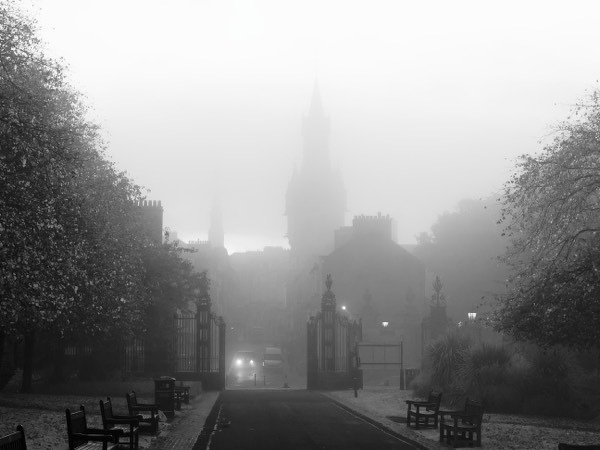
Andrew Carnegie's view of Dunfermline through the fog this morning. I'm guessing that most statues see in black and white.
Thinking about it, this is Andrew Carnegie’s usual head attire. Sometimes it’s a crow, but usually a gull of some sort.
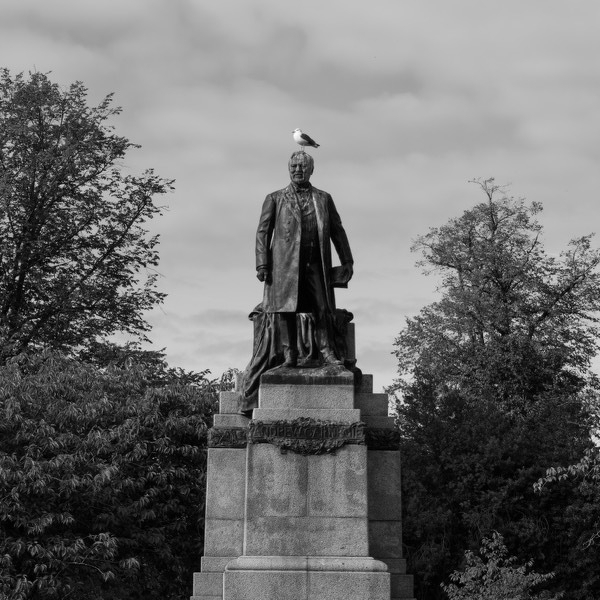
Walked into Dunfermline (Scotland) the other morning to see dear old Andrew Carnegie doing his wizard impression again.
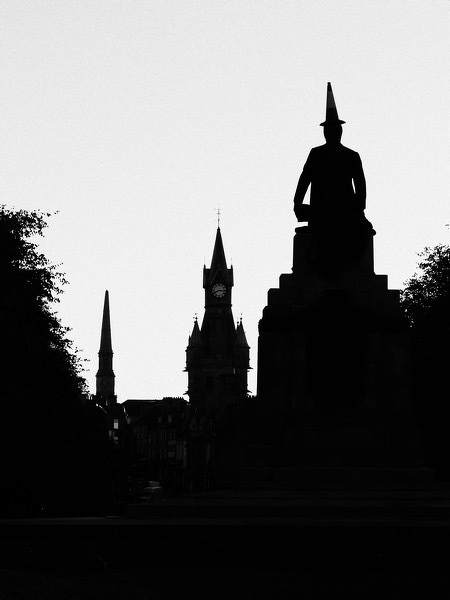

New photos, old camera
I recently worked with a class of primary school children learning about the First World War (1914-18). We spent time looking at the remarkable collection of photographs curated by the Imperial War Museum. This led to questions about what cameras were available to soldiers at the front and ultimately to me buying a Butcher’s Watch “Carbine” Pocket Camera dating from around 1912, for just a few pounds.
Naturally I wanted to see if this tiny, folding camera could still produce photographs. The shutter still seemed to work and the lens looked fine, my only problem was the obsolete film spool the camera requires. The actual film size (120) is still available and produces large negatives 6cm by 6cm. However, it is spooled onto slightly larger spindles than my old camera can handle and is twice the length. Fortunately a quick spindle trim with some scissors produced compatible film.
These images come from the first film I have put through the camera. The second was a happy accident. There is no mechanism to prevent exposing the same bit of film more than once, something I intend to take advantage of in the future.
I can’t help but wonder what images the camera captured when it was new and what its first owner thought of this tiny, technological wonder that they could carry anywhere in a pocket to capture images of life around them.


Golden turd on the Edinburgh skyline from the National Museum. It perhaps doesn’t look quite so awful in black and white.

Took some photos of several day’s accumulation of frost just half an hour before the thaw set in and it all melted.


Spent the last few days mostly on my own being ill. At least the view outside the kitchen window is pretty.

Figure from the remarkable collection of architectural fragments at Elgin Cathedral. I took this photo in February, but only just got round to developing the film.


Met this anxiety filled couple at the Burrell Collection in Glasgow this morning. Apparently they have come over from Spain.


Experimental image made with homemade RTI (Reflectance Transformation Imaging) setup. The aim is to make indistinct details on objects clearer, here on a white 19th century clay tobacco pipe.

A photo of a photo (negative) of me taking a photo of myself. The camera viewfinder shows a mirror image, so looking into the mirror I saw myself the right way round.

Part of a late Victorian/Edwardian electrical switch excavated along with some of the wiring in a local graveyard in 2015.


Another old film developed
I have had another go at film development. This time a colour film taken some time ago on an old Yashicamat I inherited from my father-in-law. There are only 12 exposures to a film, but 6cm square, so much larger than 35mm.
My expectations for the experiment were set low, but I was pleased with the results. This image was taken from Calton Hill looking across the city of Edinburgh to the old town and castle. Edinburgh is blessed with a number of hilly vantage points. This one is steep, but well worth the effort.
I am not sure how long ago the photo was taken, but the cranes on the right have been gone for some months now.
